
What We Cannot See

Updated: Sep 19
I have been thinking a lot recently about visibility.
Merriam-Webster gives three definitions of the word:
The quality or state of being seen. (Merriam actually says "the quality or state of being visible,” but I was always taught in school you don't use the word or a derivative of the word to define the word. Come on, Merriam!)
The degree of clearness.
A measure of the ability of radiant energy to evoke visual sensation.
This came up recently for me as I was cycling at 5:00 in the morning.
In an effort to get in more miles and a strong brick workout (cycling immediately followed by a run), I had planned to bike 90 minutes then run for 90 minutes. I wanted to really push myself on the bike.
I went 18 miles.
Now, you might be thinking, "That's far." And you are right. If you are thinking, "That's not very far," keep it to yourself.
Anyway…I averaged about 12 miles per hour, which is slower than I need to be riding if I am to do this Half Ironman in a month.
I had an excuse.
It was dark. Really dark.
Once I got out on the trail, I could barely see beyond the small circle of light coming from my iPhone’s flashlight. And yes, they make bike lights and headlamps. But I have been living a bit moment to moment right now and proper illumination was not on my last-minute planning list.
So there I was, riding a trail that I knew was there but could barely see. The canopy of trees overhead making it even darker.
At one point, I reached a hill where I knew roots had broken through the pavement. There are also some turns I don't know well enough to anticipate in the dark.
I slowed down. Eventually, I got off my bike. I walked it up the hill and partway down the other side.
I knew the road was there. I just could not see enough of it to move through it the way I normally would.

In addition to riding in the wee hours of the morning, I am having another problem with visibility.
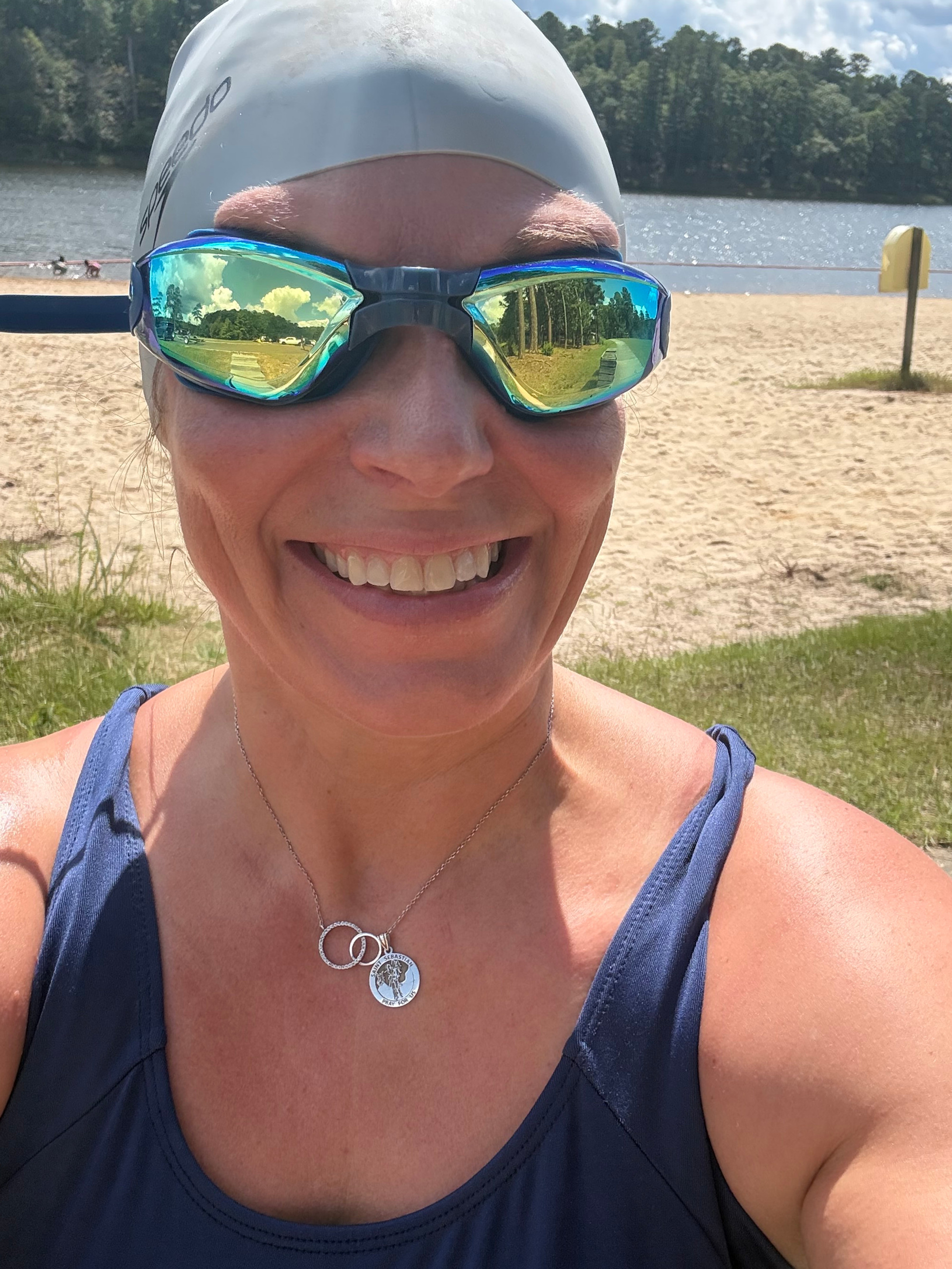
Open-water swimming.
Until recently, one hundred percent of my training swims have been in the clear City of Raleigh pools. I can see the lane line beneath me. I know where I am going. Every 25 yards I have a wall to touch, sometimes even rest against, and use to push from again.
And there is a lifeguard.
So much visibility. I can see and I am seen.
Open water offers almost none of that. The first time I put my face into the lake, it was a little shocking. My hand would extend out in front of me and then almost immediately disappear.
I could see nothing below me. There is no line telling me where to go. No wall waiting for me in 25 yards. And definitely no lifeguard.
With my bright orange buoy attached to my waist, I hope that boats can see me and I suppose I am also hoping that someone on the beach might notice if the bright orange buoy stopped moving.
Visibility, in at least two definitions of the word, is pretty low in open water. And it changes the way I move.
Six years ago, when I started as CEO of Tammy Lynn Center, I needed visibility.
The organization had been through a series of leadership changes over the previous two years. We were still very much in the middle of the COVID pandemic. It had been a stressful time.
I wanted to understand what was happening inside and across the organization.
In true fashion of believing I had a great answer, I decided we needed a staff survey. On a call with our HR manager and several staff members, including a third-shift direct support professional, I proudly announced my plan.
The staff member calmly said, "Nobody is going to do the survey."
I explained that we would have an incentive. People who completed it would be entered into a raffle.
"Nobody is going to do the survey."
I explained a little more.
"Nobody is going to do the survey."
It took him saying it three times before I finally stopped trying to convince him that my idea was good and asked the obvious question.
"Why is nobody going to do the survey?"
"Because nobody believes their opinion matters."
Well. That was a punch right in my gut.
I wanted visibility into the organization. And here was someone telling me something I had not been able to see. That people didn’t believe we wanted to hear what they had to say.
It took me a week to figure out what to do instead. One thing was obvious: the survey was out!
Instead, I met people where they were. I talked to as many staff as I could. I held focus groups with every department and every residential home. I met with staff across all three shifts. We operate 24 hours per day, which meant some staff got their CEO in the middle of the night in her pajamas.
Those conversations gave me so much more than a survey ever would. People told me what was working. They told me what wasn’t. They told me what was frustrating. What they needed. What they hoped the agency could be.
Some of what I heard was hard. And all of it changed what we did next.
Someday, I will write about what we learned and what we did because those conversations helped shape the work that followed.
I had started that journey looking for visibility. And the people I wanted to understand needed visibility too. They needed to be seen.
As a leader, seeing clearly has been so much harder than it sounds. It requires information. But information isn’t particularly useful if people don’t trust you enough to tell you the truth. Which is why the survey was never going to work.
I had to ask questions. I have had to listen when I want to explain. I have had to make room for people to tell me things that I sometimes don’t want to hear.
And I have had to learn to respond rather than react.
It has also been important to create a culture where telling the truth is safer than telling the leader what they think the leader wants to hear.
Because you cannot lead what you cannot see. But you also cannot see what people are unwilling to show you.
And I think this isn’t just about leadership.
There are people I pass every day, but really do not see. And people who pass me every day, but don’t really see me. You can know so much about a person and still not really understand them.
And then there are, for sure, parts of myself I have worked really hard to make incredibly easy for people to see. The impressive parts (which, by the way, do not include me swimming!), the competent parts, the funny parts. All the parts I know what to do with.
And then there are the messy parts. The uncertain parts. The parts I don’t have figured out yet. The parts that I don’t necessarily want anyone to see.
So as leaders, as human beings in connected relationships, what is required of us to really see another person?
Is it curiosity? Maybe. The willingness to ask instead of assume? The willingness to hear an answer that does not fit the story you have already written?
I think that it is all of those things.
I also think it is creating safety. Enough safety that another person will show you something you couldn’t otherwise see.
Which brings me back to that third definition from Merriam-Webster: “A measure of the ability of radiant energy to evoke visual sensation.”
The definition is both so technical and in a sense so poetic.
Something can be present and real, and still fall outside of my ability to see it.
Just like my employees who were feeling not heard, not seen. Their experiences were very real even before I could see them. Just like I knew the bike trail was there even though I couldn’t see it. The bottom of the lake exists even when I can’t see past my elbow in the water.
In life and in leadership, it has been so important for me to understand what I cannot see. In myself. In my relationships. In my work. And in the people around me. And it hasn’t really had anything to do with getting better at looking.
It has meant becoming more aware of my own blind spots. Being curious about the things I don’t understand instead of filling in the blanks myself. Asking questions and (wait for it…) actually listening to the answers.
It has meant creating safety for people to show up as they are and show me something that I might have otherwise missed.
And maybe the hardest of all, it has meant being willing to show the parts of myself that aren’t always easy to put on display. When I don’t know. When I am uncertain.
All of this talk about visibility started because I couldn’t see two feet in front of my bike.
When I couldn’t see, I didn’t stop. I slowed down. I let my eyes adjust. I paid closer attention. I moved differently. And I still kept moving forward, knowing that what I could see was not all that was there.


Comments